How do you build consensus when outsiders have rarely been trusted?
After thousands of years living off the land in the Pacific Northwest, followed by decades of colonialism and forced cultural assimilation, the Musqueam Indian Band needed to plan for the next generation of a growing population, but trust was a major challenge.
27%
of all Musqueam Indian Band members participated.
211
community members pariticipated in the design workshop.
9 of 9
members of Chief and Council supported the final plan.
THE PROBLEM
A long-term vision for 400 acres, and a community that had to believe in it
The Musqueam people have lived on the lands now called Vancouver for thousands of years. Today, roughly 1,600 members hold about 400 acres, a fraction of their ancestral territory. Chronic flooding limited what they could build. Housing was short, and families were left without options. Decades of colonial policy had pushed the band into leasing much of its land to private developers and a golf course just to pay for basic utilities.
The band needed a long-term vision for that land. A planning process that didn’t earn the trust of Elders, youth, on-reserve and off-reserve members, and all nine members of Chief and Council wasn’t going to get far.
Before we drafted a survey, we listened.
Our team met with Chief and Council, toured the land with staff, and sat with Elders to learn Musqueam history before designing a single session. The process took the shape of the community, not the other way around.
WHAT WE DID
1. A community dinner to connect and reconnect.
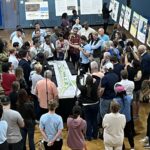
We opened with a Community Dinner, one of the first large gatherings since COVID, with 150+ members seated with their extended families. We captured ideas live through visual note-taking, and a highlight video reached people who couldn’t be there.
2. Many ways to participate.
A dedicated website with interactive mapping, a Facebook group, email, and online surveys, plus newsletters in both English and hən̓q̓əmin̓əm̓ (the Musqueam language) and display kiosks at key community locations.
3. Engage young people through arts.
A youth art competition that gave young Musqueam members a real voice in imagining the community’s future, and fed directly into the planning.
4. Six days, one room, interactive discussions and designing in public.
With more than 20 specialists in planning, landscape architecture, transportation, and environmental engineering set up at the Musqueam Cultural Centre for seven topic sessions. Community members worked right alongside them, drawing on maps, moving pieces around a 3D physical model, and sketching housing options as the conversation happened.
WHAT CHANGED
The Musqueam Village (IR2) Plan is a multi-generational development framework grounded in the community’s own Land Code. Fully built out, it is expected to create hundreds of permanent jobs and thousands of construction jobs, along with paths to entrepreneurship and generational wealth, on Musqueam’s terms.
The community voted to move ahead with feasibility analysis and detailed site planning for the first phase of the plan. Elders, youth, on- and off-reserve members, and all nine members of Chief and Council reached that decision together.
WHAT THIS MEANS FOR COMMUNITIES LIKE YOURS
In our experience, when a community stalls on a big decision, it’s usually because people don’t trust how the decision is being made. The plan itself is rarely the sticking point. If you have a land use, housing, or governance question that needs broad agreement, ask whether people will believe in how the answer was built.
Facing a decision that needs everyone on board?
We’ve built community support for land use campaigns, Indigenous planning processes, environmental initiatives, and municipal projects.
Feel free to get in touch. We’re happy to talk it through.