Earning trust after decades of displacement and delay.
The City of Pensacola wanted to design and develop a $25 million neighborhood park and flood-control project on land where 50 years of broken promises had hardened into distrust. Here’s how strategic community engagement turned skeptics into supporters, and set a new citywide standard in the process.
1,080+
Residents and neighbors engaged in the design process.
31
Public events, stakeholder meetings, and topic workshops.
1,327
Visual preference data points collected.
455
Survey responses via online and paper questionnaires.
THE PROBLEM
Fifty years of displacement, and a community waiting to be let down again.
In the 1970s, construction of the I-110 interstate spur resulted in the displacement and demolition of hundreds of primarily African-American homes, businesses, and churches from Pensacola’s Eastside Neighborhood. The highway left behind a physical and emotional scar that never fully healed. For two decades, city leaders had floated designs and plans for a new park on the now-vacant land beneath the interstate, but none ever materialized. The community had learned not to get their hopes up.
Then the City secured $25 million in federal grant funding for a transformational 110-acre redevelopment: a community park combined with critical stormwater infrastructure to mitigate regular flooding, which had affected the surrounding neighborhoods and polluted Pensacola Bay.
The design was technically complex. The politics were delicate. And the community had every historical reason to assume they’d be ignored again.
Despite the challenging science and hydrology of the project, the central challenge wasn’t engineering…it was trust.
OUR APPROACH
Lots of listening. Then we had to prove what we heard.
Too many public engagement efforts look the same: a public meeting or two (often across town from the actual project), a meaningless survey, and a comment box that is never monitored.
Then the design turns out just like the engineers planned it all along, and the community realizes they weren’t really being engaged; they were being patronized.
For this project, we designed a layered engagement strategy that moved from trust-building to co-creation to validation. Throughout this effort, we had one non-negotiable standard: we considered every piece of community input, evaluated it, and either included it in the final design or explained why it wasn’t feasible.
If a resident asked for something and the team couldn’t deliver it, we explained why. If the community pushed for a change and the design team incorporated it, we pointed to it publicly.
Here’s how that played out:
1. Convene community leaders first.
We brought stakeholders and neighborhood leaders into the room before any public announcements — establishing trust at the leadership level and surfacing the community’s institutional concerns early.
2. Reach broadly and equitably.
Direct mail, social media, local partnerships, and a dedicated project website ensured we didn’t just hear from the loudest voices — we heard from the whole neighborhood.
3. Explain the constraints honestly.
We didn’t hide the technical tradeoffs. Community members deserve to understand why a design looks the way it does — and they responded with more confidence, not less, when we were direct about the limitations.
4. Make input visible in each design iteration.
At every revision milestone, we showed the community exactly what had changed, and why. This created accountability — and momentum. People came back to subsequent meetings because they saw the process actually working.
5. Close the loop with a final community event.
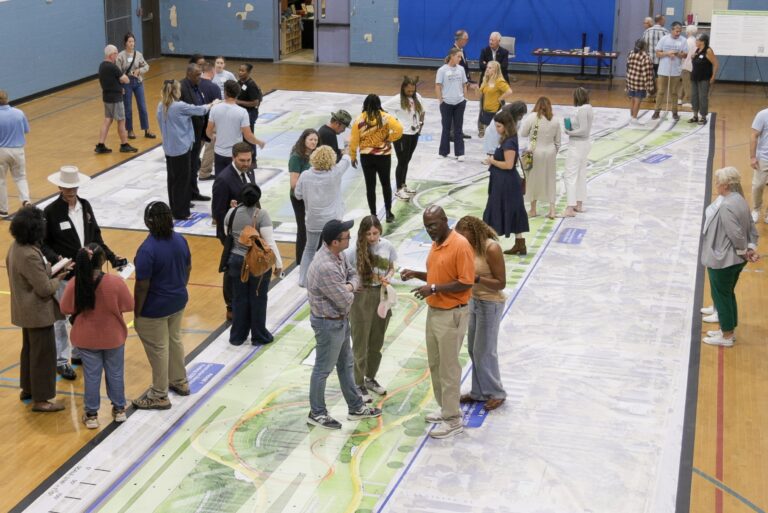
The year-long process culminated in a public reveal featuring a 63-foot floor map of the full park. This allowed 120+ attendees to physically walk through the design. It celebrated what the community built together, not just showing what was done to them.
THE OUTCOME
Overwhelming community support. A design the neighborhood owns. Construction beginning in 2026.
The final design meeting drew over 120 residents, city staff, and elected officials, and the response was overwhelmingly positive. More importantly, the community could point to specific features and say: “We asked for that.”
City leadership recognized the process as a model for how Pensacola should approach all major community development projects going forward.
"This project has set the standard for what community engagement in our City should look like."
Pensacola Mayor D.C. Reeves
The $25 million Phase 1 development is on track to break ground in early 2026, not in spite of community engagement, but because of it. Projects that skip this step face delays, litigation, and public opposition that can cost far more than the engagement itself.
WHY IT MATTERS FOR YOUR PROJECT
If your project touches a community, the community is part of your project.
Infrastructure, land use, environmental, and municipal projects fail for all kinds of technical reasons — but they fail for political and community reasons far more often. A $25 million project with no community buy-in is a $25 million liability. Strategic engagement isn’t a box to check. It’s the thing that determines whether your project gets built.
Special thanks to the project design team, led by Geosyntec Consultants, supported by park designers Michael Van Valkenberg Associates, and landscape architects Jerry Pate Design.
Need help engaging your community around a complex infrastructure or development project? We’d be glad to discuss how strategic community engagement can turn challenging projects into community successes.